task analysis:
“The study of what an operator (or team of operators) is required to do (their actions and cognitive processes) in order to achieve system goals “
(Stanton, Salmon, Walker, Baber & Jenkins, 2005, p45)
My experience of doing a task analysis was observing my dear friend, Bob, run wire on a wall. Bob is a certified electrician who does all kind of electric jobs and this particular day he was having fun running wires from a broken socket for a washing machine and I was breathing down his neck. I observed his work, ask him a few questions and created a list highlighting the steps he took to complete the task. He wasn’t very happy to be hackled with questions all the time but I am pretty sure he was proud to help out his best friend with his assignment.
In simple terms, a task analysis is listing out the steps to do a certain task. For example, to vacuum the floor we follow the following steps:
- Get the vacuum cleaner out from the storage room
- plug it into the outlet
- attach the attachments
- clean the floor
- empty the dust bag if it is full
- put the vacuum and other tools back in the storage room
Below is the screenshot of the task analysis of my friend’s job.

Continue reading below to understand why do we do a task analysis, its different types, how to do them and the pros and cons of each type. Enjoy the read:
Why is task analysis done?
Task analysis is done to understand how users perform a certain task. The users can be experts or ordinary users, and it depends on the intention of doing the analysis. If we are running a usability test for marketing products we would want to observe how ordinary people perform a certain task and use that information in designing our products. Task analysis of experts will help in designing training programs and minimizing risks.
There are many reasons to perform a task analysis. One of them is to assign roles to different tasks in an organization. For example, at an airport, task analysis can be done list out all the steps a passenger should go through for security screening and from that list, they can assign different roles for security personnel to process the passengers. This will reduce overstaffing or understaffing. Task analysis also increases the efficiency of work. Resources can be allocated to part of the work where there is a high demand for resources. Better schedules can be created with knowledge of what is needed or what will be available at what point of time during the process and that ensures smooth work-flow. Task analysis also helps researches compare how users would perform the same tasks using different concepts to down-select concepts.
There is two popular task analysis.
• Hierarchical task analysis (HTA)
• Cognitive task analysis (CTA)
Hierarchical task analysis (HTA)
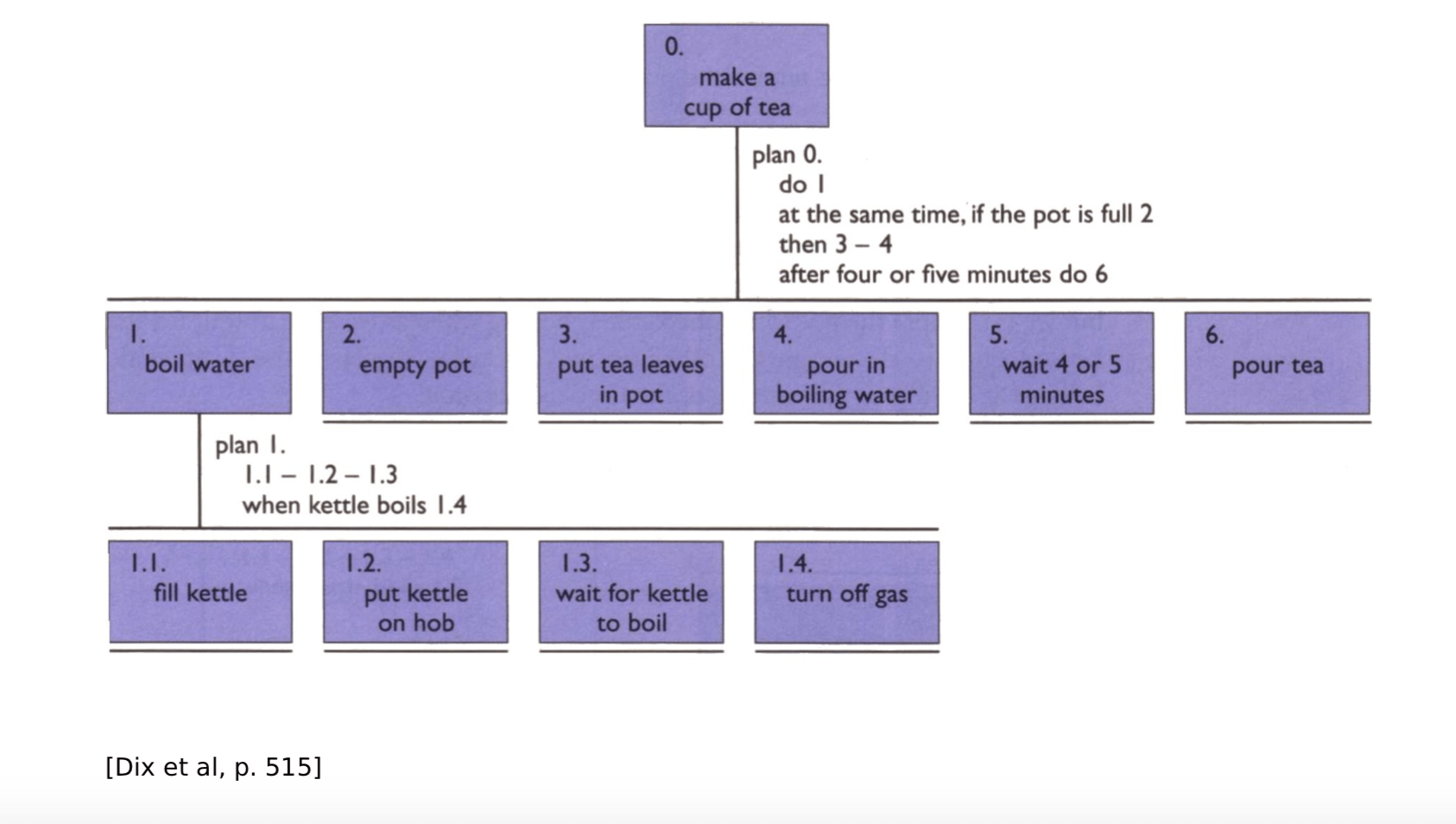
HTA is the most widely-used type of task analysis and it describes the task according to the steps and sub-steps in sequence. The use of this type of analysis is to help in function allocation, training program development, instructions for use development, risk assessment and workload assessment.
So, how do we conduct an HTA?
We can follow the following steps to do an HTA.
- Define the research goals
- Collect data
- Define the overall task
- Define the overall task steps
- Decompose steps into sub-steps
- Identify the sequence of steps and sub-steps
- Determine how to present the task analysis
There are several advantages to conducting HTA. Some of them are listed below.
- Enables you to compare design concepts and products
- Describes a number of different potential task routes
- Applies to a wide variety of domains
- Provides input for other HF methods
HTA also comes with some disadvantages. Few disadvantages of conducting HTA are
- No info about cognitive task components
- Laborious and time consuming for complex tasks
- Requires work up-front to collect task data
- Requires in-depth knowledge of task and product(s)
Cognitive Task Analysis (CTA)
Compared to the physical steps taken to complete a task a CTA focusses on capturing cognitive function and workload. This involves understanding users judgments and strategies, prior knowledge while approaching and performing a task. This method may capture steps that might or might not have physical actions.
To conduct a CTA we follow following simple steps.
• Define the task
• Select appropriate participants
• Collect data
• Conduct an interview to understand which steps require most cognitive effort, which steps require expertise, which steps require decisions and judgments and what are the potential errors during each step.
There are several advantages to conducting a CTA. Like,
- Provides information about cognitive task components
- Enables you to identify key decision points
- Enables you to identify steps for which experience is
essential
CTA also comes with few disadvantages. Such as,
- Relatively time-consuming
- Relatively expensive
- Quality of data depends on the quality of participants
- “Thinking aloud” can distort task performance and
cognitive steps (key data)
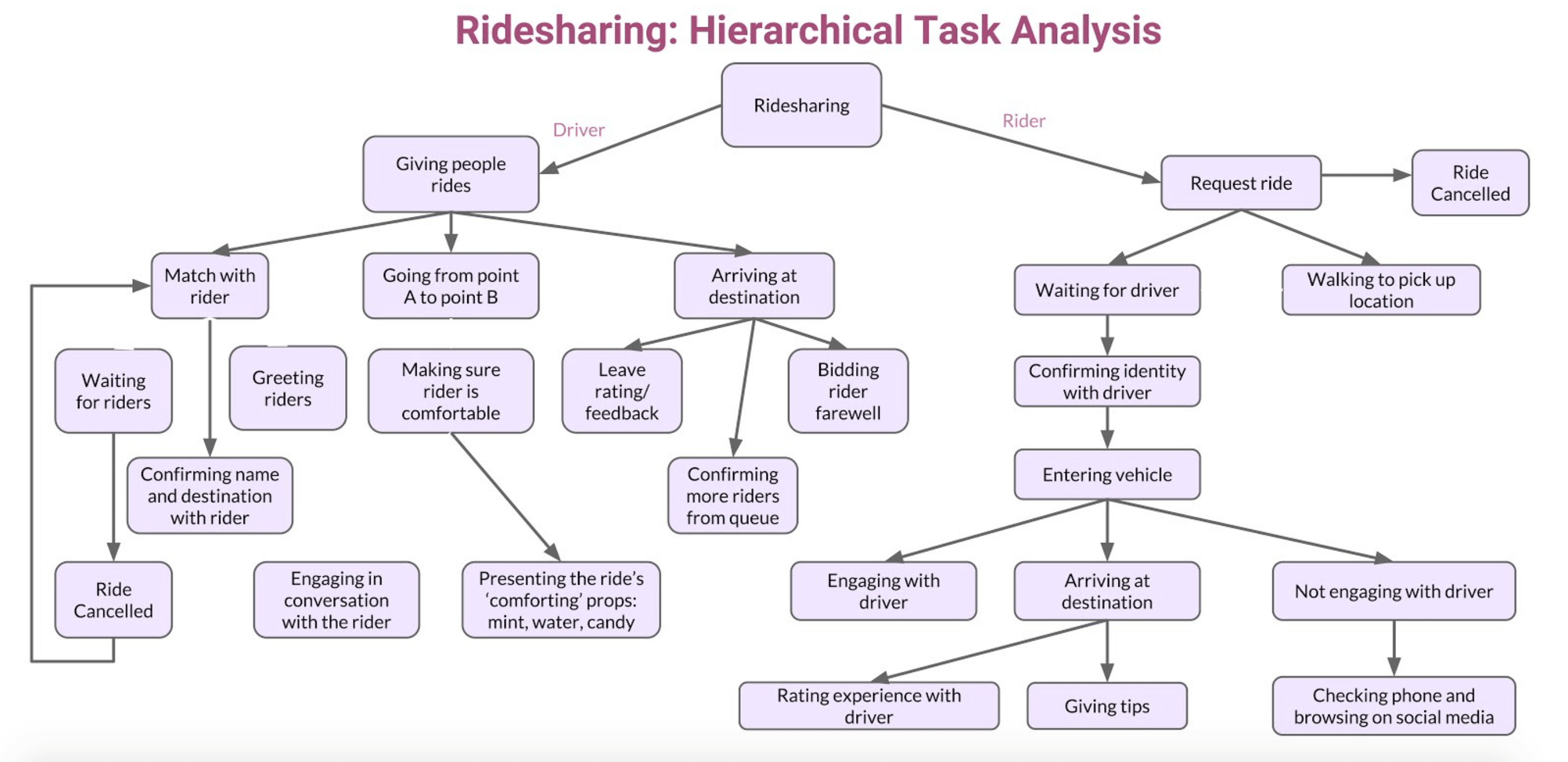
Task analysis gives a clear picture of the entire process. I leave you with this picture from https://medium.com/@tonyanguyen_94663/reimagining-the-driver-rider-relationship-in-ride-sharing-applications-b787cab83e2c where the blogger explores the relationship between driver and rider in ride-sharing apps.
 milan101
Leave a reply to milandahal213 Cancel reply