Why Question #3
On November 6th Massachusetts voters will be asked to vote YES or NO on three questions. We have chosen Question #3 to build our recommendation system because of following two reasons:
- It is predicted to be the closest vote in this election, and
- The ballot’s wording of the question is confusing. So people might need some help there.
Question #3 asks if voters would like to remove the law that prohibits the discrimination on the basis of gender identity in places of public accommodation. If the majority vote YES to this question it will be illegal to discriminate people from using public accommodations. However, some critics argue that voting NO doesn’t mean saying yes to transgenders discrimination.
The answer to the question may look simple: people supporting LGBTQ rights will vote YES and people who are intolerant/ ignorant of their rights will vote NO. But it might not be so simple. There are two opposing camps working very hard to convince people to vote in their favor.
Keep MA Safe and Freedom Massachusetts have some strong arguments on why people shout vote NO and YES respectively to Question # 3. We have taken arguments from both sides on whose basis we have tried to formulate our questions so that voters can make informed choice.
The Five Questions
One of the arguments supporting the law is that transgenders should have equal rights as cisgenders. And it is a pretty basic question. People who vote NO on this question would probably not vote YES on November 6th. So we begin with a question asking if they support LGBTQ rights and this question weigh significantly higher.
Over 70% of Americans are Christians, and Bible, the holy book, distinguishes binary sexes: male and female. Of course sex and gender are different and a lot of Christians have become generous to the idea of race, gender and sexuality and issues transgenders have entered mainstream discourse (according to a paper on Race, Gender, Sexuality, and Religion in North America). But there are people who still make choices based on personal and religious beliefs and we want to address it with our second question.
The strongest argument put forward by the NO camp is that this law is really about restrooms. They are voicing concerns that once it becomes legal for transgenders to enter the restroom of the gender they identify with there will be danger to all women and children. They are concerned with their safety in changing rooms, restrooms, spas and women-only salons. “It’s not about discrimination. It’s truly about safety and privacy in these public spaces where women are partially dressed” says Debbie Dugan, chair of the Keep Massachusetts Safe group in one news article . While the supporters of YES argue that there are laws already in place that make it illegal to harm or harass people in restrooms. These laws are used to prevent assault, keep people safe, and hold offenders accountable. Protecting transgender people from discrimination hasn’t changed that. And there’s been no increase in such incidents in Massachusetts since the state’s protections passed in 2016.
While the supporters of the YES campaign argue that “Acting in an appropriate and respectful manner, no matter what restroom you’re in, is important… don’t see it as an issue that transgender people are more dangerous than people who are not transgender.”
This is clearly a very important question. So we ask voters in our third question if they are comfortable sharing bathroom with transgenders. This question asks if the voter is personally comfortable in sharing the restroom specifically.
Our fourth question is an extension of the third question. People may think mostly about restroom when they think about public accommodation but it can mean much more and the law takes into account all the public accommodations i.e. hotels, restaurants, swimming pools, buses, etc. An online news article quoted a transgender woman from MA as she recounted her experience of being thrown out of a restaurant before the law went into effect. “I’ve been refused service in a restaurant simply for being transgender. I’ve been asked to leave a place — ‘asked’ is the polite word. I’ve been told to leave a place for using the women’s restroom”. So the voters should really understand that this is not only about restrooms and will make impact on a lot of spaces. NO supporters quote the example of a waxing salon where a person identifying as a women but with a male body threatened to file complaint against a spa for not performing full Brazilian waxing and they argue that this might become a commonplace once the law is voted YES.
The last question asks voters if they believe that transgender people should have access to same public spaces as everyone else. It is different from third and fourth questions as it takes the voter’s belief into account. It talks about transgenders having access to public spaces in general and not about voter’s personal comfort or discomfort in sharing the same space with transgenders. We believe this question pretty much sums up other questions and has the highest significance to the question in hand.
Challenges of Question #3
The supporters of YES argue that this law guarantees legal protection for transgenders in public spaces against discriminations. The safety of women and children will not be affected by ensuring this basic human right to transgenders. “Yes” on 3 would preserve a state law that prohibits discrimination against transgender people in places of public accommodation — notably, bathrooms.
The supporters of NO interestingly support that transgenders should be respected but argue that no law should undermine its citizens’ freedom of association, and should trust them to use their own judgment when gender identity is at issue. They also argue that Massachusetts has already shown to accommodate transgenders without the law. They are concerned that the law might ignore the sensitive issues of privacy and vulnerability. They think that there are many cases where women and girls have felt uneasy because of the presence of people with mismatched bodily sex and gender identity.
In an article in Boston Globe the writer has quoted a supporter of repeal as “There is a lot of misinformation about this… What we are saying is to repeal the law so that the Legislature can start over to make a law that provides accommodations for everyone”.
So Question # 3 can be really challenging to answer. We have built a system to help people answer this question.
Mechanism for capturing user inputs
Our mechanism to capture user input is a web application that allows a user to choose ballot questions to get recommendations for. This system is visually outlined with our UI wireframe as shown below. The user will respond to 5 yes or no questions that relate to the ballot question. At the end of the list of questions, the user will be given a recommendation on how they should vote and then are asked if they agree with our system’s decision.
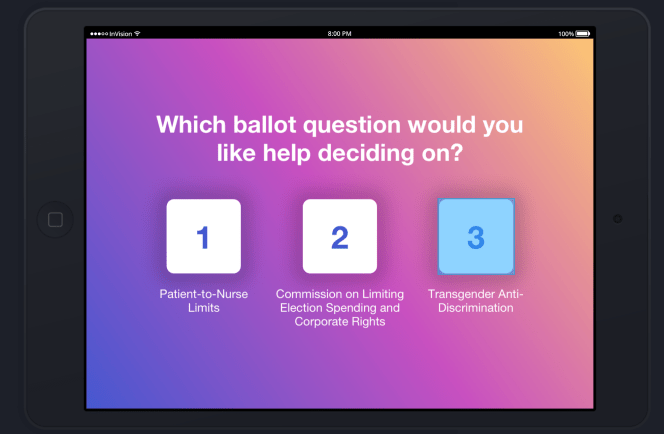
Description of how data are being gathered, compared, and ultimately how the decision of what candidates to recommend is being made
Once the user chooses a question, they will see a brief 1 sentence introduction to that question. This is done for ethical purposes to ensure that the user has an understanding of the question before we provide them with a recommendation. Additionally, this ensures that the user feedback after our recommendation will be useful for training the machine learning algorithm. Users need to understand the question on their own to say whether or not they agree with our recommendation.
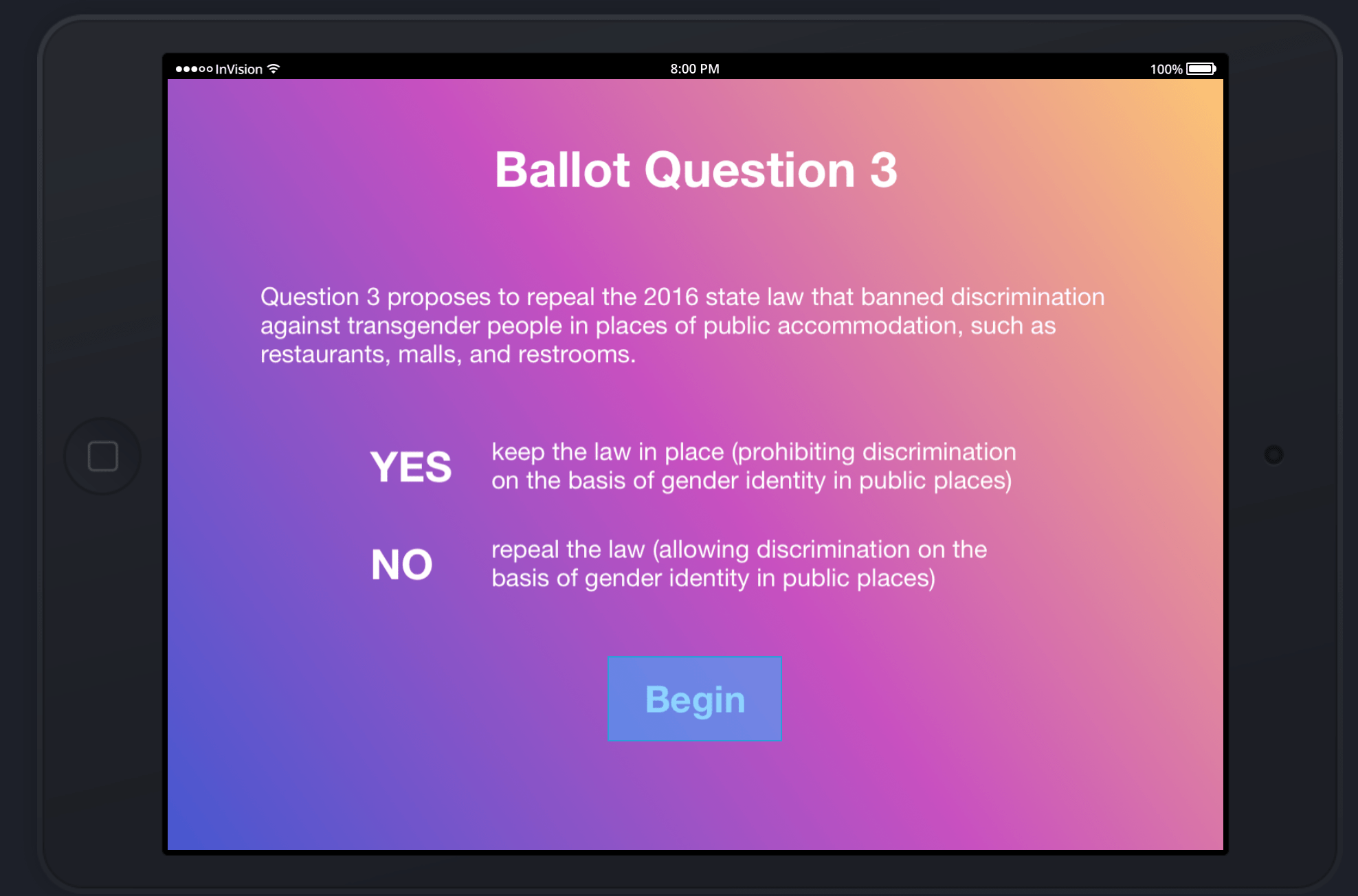
We came up with 5 questions with different weights to gauge how a user might want to vote. These questions are based off of some preliminary research into the topic. This research gave the team an understanding of how certain types of people might vote on particular questions and the reasons that they vote the way they do. This way, we can distil common reasonings into yes or no questions to present to a user.
Initially, we assign weights to the questions that our group agreed on. The 5 questions must have a total weight of 10 points. We agreed on weights by thinking about the relevance of the yes or no question to the ballot question. For example, the question “Do you believe that transgender people should have access to the same public spaces as cisgendered people?” is heavily related to what the actual ballot question is getting at. Because of this, we decided to rate this at a 3.5. Answers in agreement of the proposal are given points by weight. If users receive more than 5 points per ballot question, they will be recommended to vote yes on that question. However, the weights of questions can change through user feedback and machine learning. This will be further explained in the machine learning/big data piece of this assignment.
| Question | Wording | Weight |
| 1 | Do you support LGBTQ rights in general? | 2.5 |
| 2 | Do you have any personal or religious beliefs against gay/transgender people? | 1.5 |
| 3 | Would you be comfortable sharing gendered spaces (such as bathrooms) with transgendered people? | 1 |
| 4 | Are you comfortable sharing public spaces with transgender people? | 1.5 |
| 5 | Do you believe that transgender people should have access to the same public spaces as cisgendered people? | 3.5 |
Mechanism for conveying the recommendations to the voter
As stated earlier, we chose to create a simple web app to help voters decide how to vote on question 3. We first created some initial concepts as we tried to determine the best way to both display the question and allow voters to answer (shown below).

Initial Designs
Ultimately we settled on the first concept due to its simplicity and readability. We then took this design and created the remaining screens, which we then combined into this prototype.
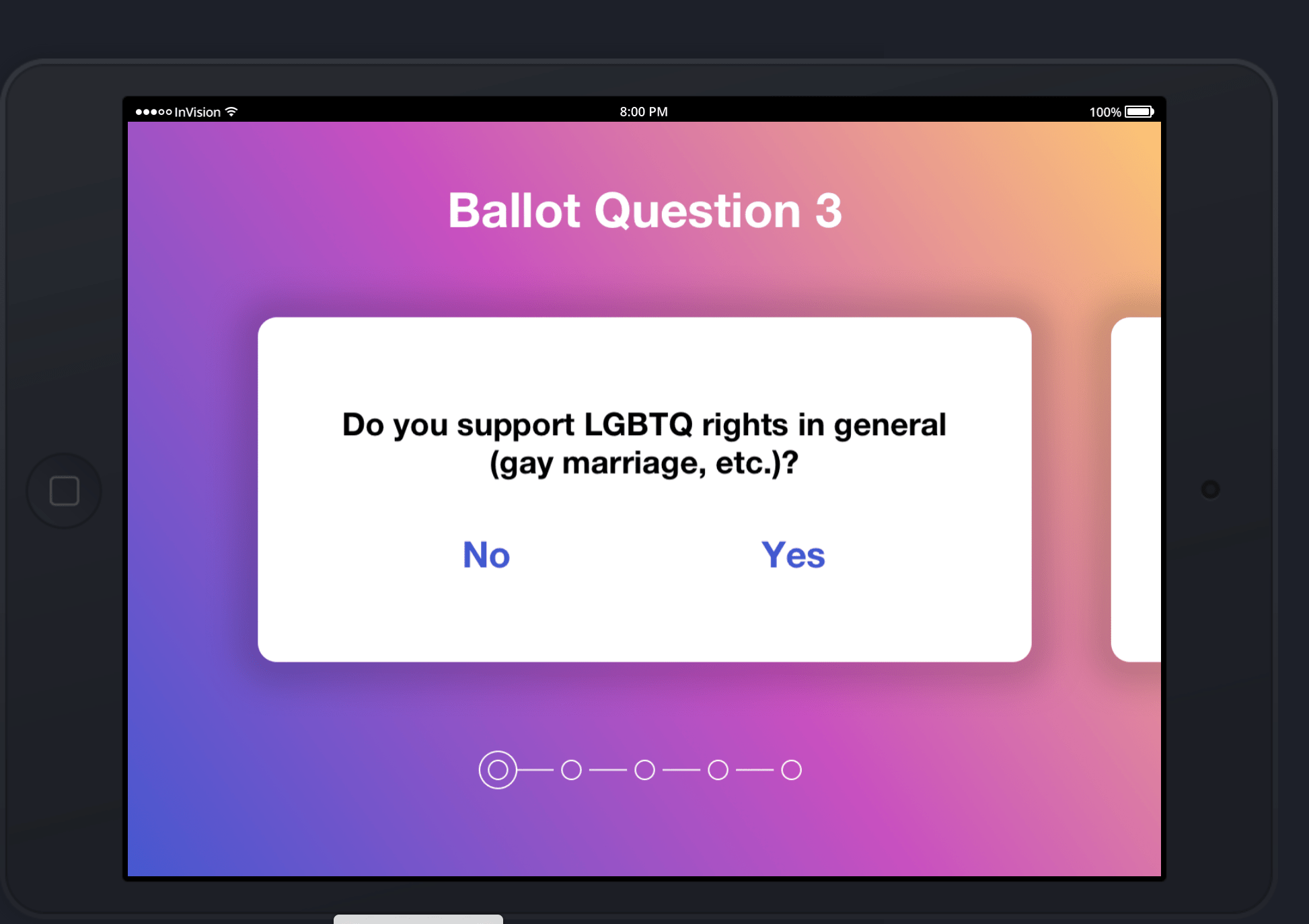
Final Design
You’ll notice some additions and differences between these screens and the initial concept. We changed the color of the YES and NO buttons to better indicate their clickability, as well as added a constant header and progress bar. This progress bar shows the user how many more questions they have left to answer, as well as lets them navigate back to any of the previous questions (indicated by a filled circle). The current question is shown via an outline around the circle. A user may also move back a question by clicking on the partially shown question card on the left (or by swiping on a mobile device). We do not let users skip a question either via the progress bar or swiping to the right – each user has to click YES or NO on the current question in order to move on.
Please keep in mind that the current prototype is only meant to showcase the flow of questions – it is thus lacking most of the interactions and animations that we envision for the final product. For instance, there are no hover effects on the YES and NO buttons, and we don’t show animations on the progress bar or the cards due to the limited functionality of our prototyping tool, InVision. More importantly, InVision doesn’t have a way to implement the weighted point system that our system will use to actually determine how a user should vote – currently, the prototype chooses YES or NO based on your answer to the last question only. In the final product, the voter’s recommendation will be decided based on the point system we described earlier.
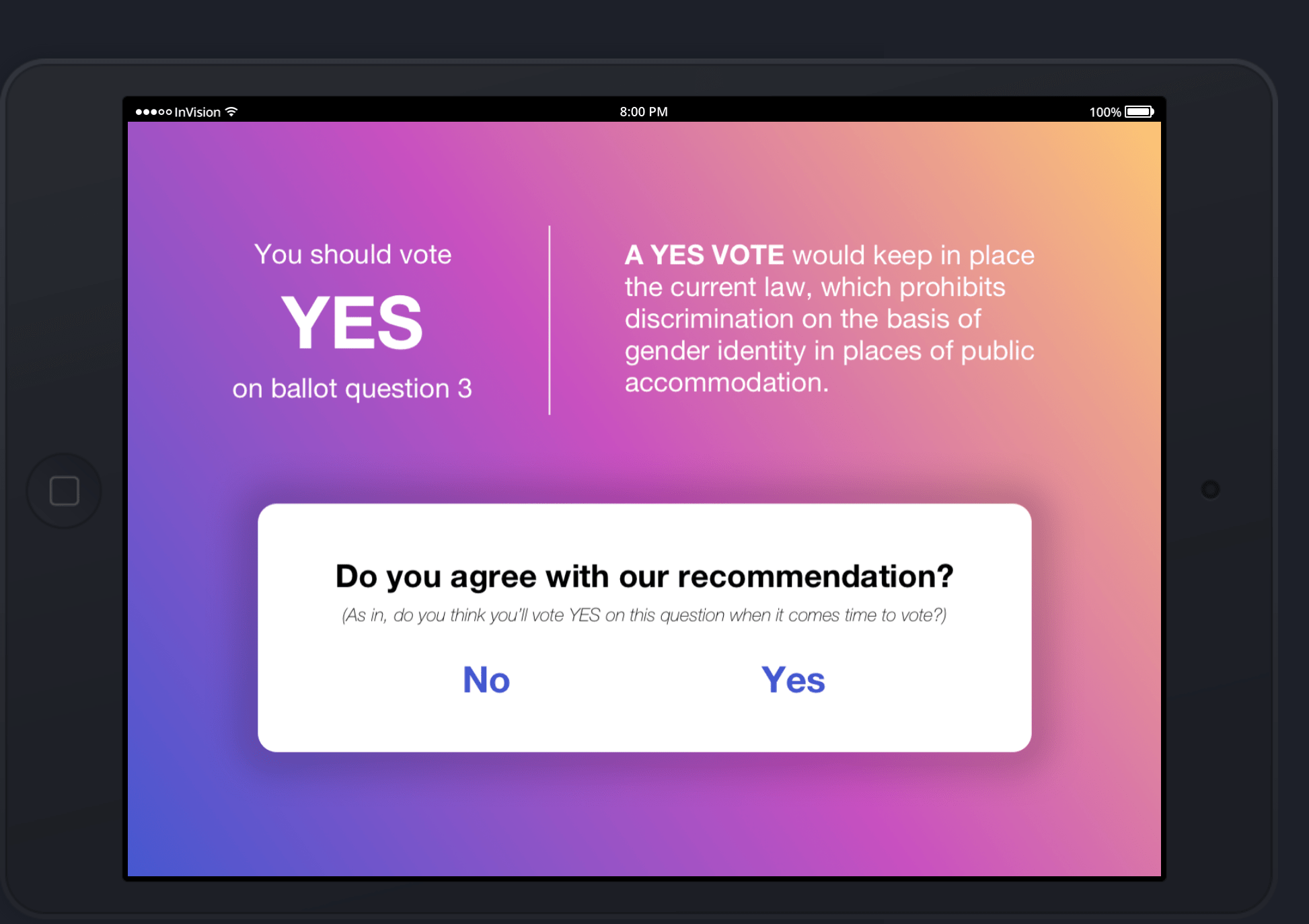
Screen showing recommendation and getting feedback from user
Feedback from 5 non-college aged voters
Five non-college aged voters were asked to give a review on the system at hand, and they were asked to decide whether or not the questions asked were representative of the issue at hand. Participants were also asked questions about their thoughts on systems like this in general.
All five reviewers enjoyed the flow of the application, and they all liked how the questions chosen were clear and concise. Many of the people also mentioned how they liked how a system like this breaks down the law into different pieces. A system like this also helps to put the issue or law at hand into the context of people’s lives, rather than just having some words on a page. Reviewers also stated the importance of explaining what a yes vote and a no vote means, especially because the wording on ballots can sometimes be confusing and full of jargon, and they liked how this was present in our system. Two of the reviewers mentioned that this system would be great for those who are strapped with time and cannot determine how to vote in a small period of time (This also brings up some ethical concerns, however).
To expand on showing the effects and implications of a law with the system, one reviewer said that a system like this would have been useful for a particular issue in their home state of California, where there is a bill being proposed for housing for the homeless. While, she thinks that the overall bill is good, the passing of this bill would raise taxes enormously, and she would not have known this if she had not done any research on the issue. If systems like this included key information like this, it could help voters to understand each feature of a bill at hand, which could be important for complicated issues.
One participant also commented on our 6th question, which is “Do you agree with our recommendation (As in, do you think you’ll vote [YES or NO] on this question when it comes time to vote)?” and stated that this question makes the system as a whole seem more invasive, and it reinforces the idea that you do not have to vote in the manner that this system recommends.
Two reviewers brought up many issues and concerns with a system like this. Both reviewers said that they enjoyed using this system in particular but were concerned about systems like this being used ubiquitously. One reviewer said, “The idea of a system telling you how you should vote is unethical, as there is more to consider when voting on an issue than what a system tells you”. The other reviewer did not trust a system like this and was afraid that voters would become too reliant on a system like this, and that voters would not do proper research on the topic at hand. These systems are also very subjective to the creator and designer’s interpretation of the issue at hand. The creator or designer may fail to include key questions in the system that would sway voters a certain way, or they may add too many questions about a certain aspect of the bill which could be harmful. As this system determines which way someone should vote based on past preferences, and question number six, there is also chance that the system could be flawed, abused, and/or hacked. These two reviewers raised concerns about this happening, especially with the frequency of large data breaches now.
Overall, reviewers enjoyed using this system as it is easy to use, straightforward, and breaks down the issues at hand into their different components. It is important, however to understand the concerns and ethical issues with a system that will recommend to users how to vote.
Below is a chart showing how the five reviewers generally felt about our system and systems like this being implemented.
| Person | Did you like using this specific system? | Are these questions representative of this particular issue? | Would you use systems like this to decide how to vote on different issues in the future? |
| 1 | Yes | Yes | No |
| 2 | Yes | Yes | Yes |
| 3 | Yes | Yes | Yes |
| 4 | Yes | Yes | Yes |
| 5 | Yes | Yes | No |
Discussion of how the system might be extended with machine learning and big data.
After the system gives a recommendation, it asks the user if they agree or disagree (as in, whether or not they will use that recommendation when they actually vote). With machine learning in mind, this feedback will help train our program to alter the weights of each question as well as the cutoff point. The altered system would have the goal of correctly predicting how users will vote and can look at trends in answers to figure out how much each question really means to users.
From a big data perspective, we can observe and predict the outcome of certain ballots. Users who receive a yes recommendation and agree with it as well as users who receive a no recommendation and disagree with it can all count as yes votes in our prediction system. The inverse is also true. If you wanted to dive even deeper into the data behind our system, you could find stronger correlations between particular questions and how people decided to vote. If just one question in our system could predict how 90% of people will vote, it could be pretty interesting to politicians.
 milan101
Leave a comment